
Portraits in the manner of William Adolphe Bouguereau, French, 1825-1905
Landscapes in the manner of Jan Van Der Heyden, Dutch, 1637-1712
Paintings in the manner of
Inspiring Smiles Forever
Complete Works, Portraits, Landscapes, Still Lifes, Sculpture, Lego Artist...
Sign up for yearly notices by sending an e-mail to newart-subscribe@tomlohre.com
Post comments on https://www.facebook.com/LohreFineArt
Tom has been a fan of Orbiter since 2003. From time to time he found himself opening Orbiter to advance his knowledge of space travel. His daughter went to the Huntsville Astronaut Camp and for the life of him he could not get her interested in the next best thing to real space travel, Orbiter. His first space simulator was Microsoft's Space. He even has a unopened copy of game as it will only go up in value as a collectible.
Since reading the Martian and seeing the movie, he has new interest in studying space dynamics. Thank you for the best simulator in the universe.
As a working fine artist looking for new adventures to paint, Tom got press credentials from "Heavy Metal Magazine" and was at the first space shuttle launch. I got press credentials for the Voyage encounters with Saturn, Uranus and Neptune. He was representing Rolling Stone Magazine during the Neptune encounter and got his credential taken because he could not name the editor, he was working for a sub, sub, sub editor. But he did learn about the American Interplanetary Society. Finishing the rest of the encounter with the best supporters out there.
People are not quite ready for space paintings. The most popular are planets with fictional spacecraft from Star Trek and Star Wars.
The next space painting will be to finish the five by five foot painting of Saturn he started placing a young astronaut in the foreground admiring the view from the comfort of her craft.
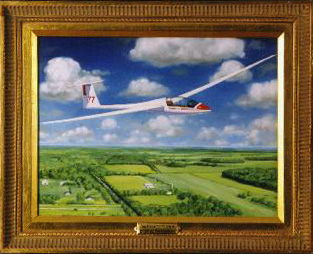
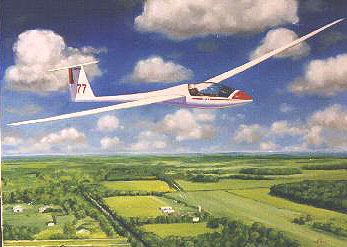
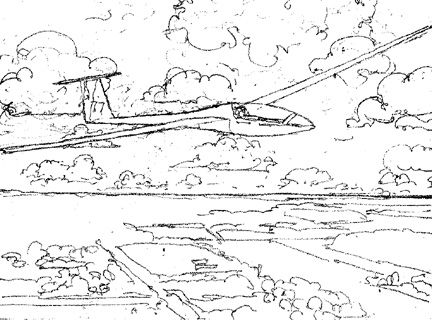
This is the preliminary sketch for Jim’s Christmas Gift.
It is done on the 16” x 12” canvas and the final painting will be in a simulated gold leaf frame with plaque. The ground shows the Caesar Creek field. There will sailplanes lined up on the field. The clouds will be little popcorn clouds indicative of great thermals. Inside the cockpit will be Jim looking this way.
7” x 5”, Oil on canvas Painted on the maiden voyager.
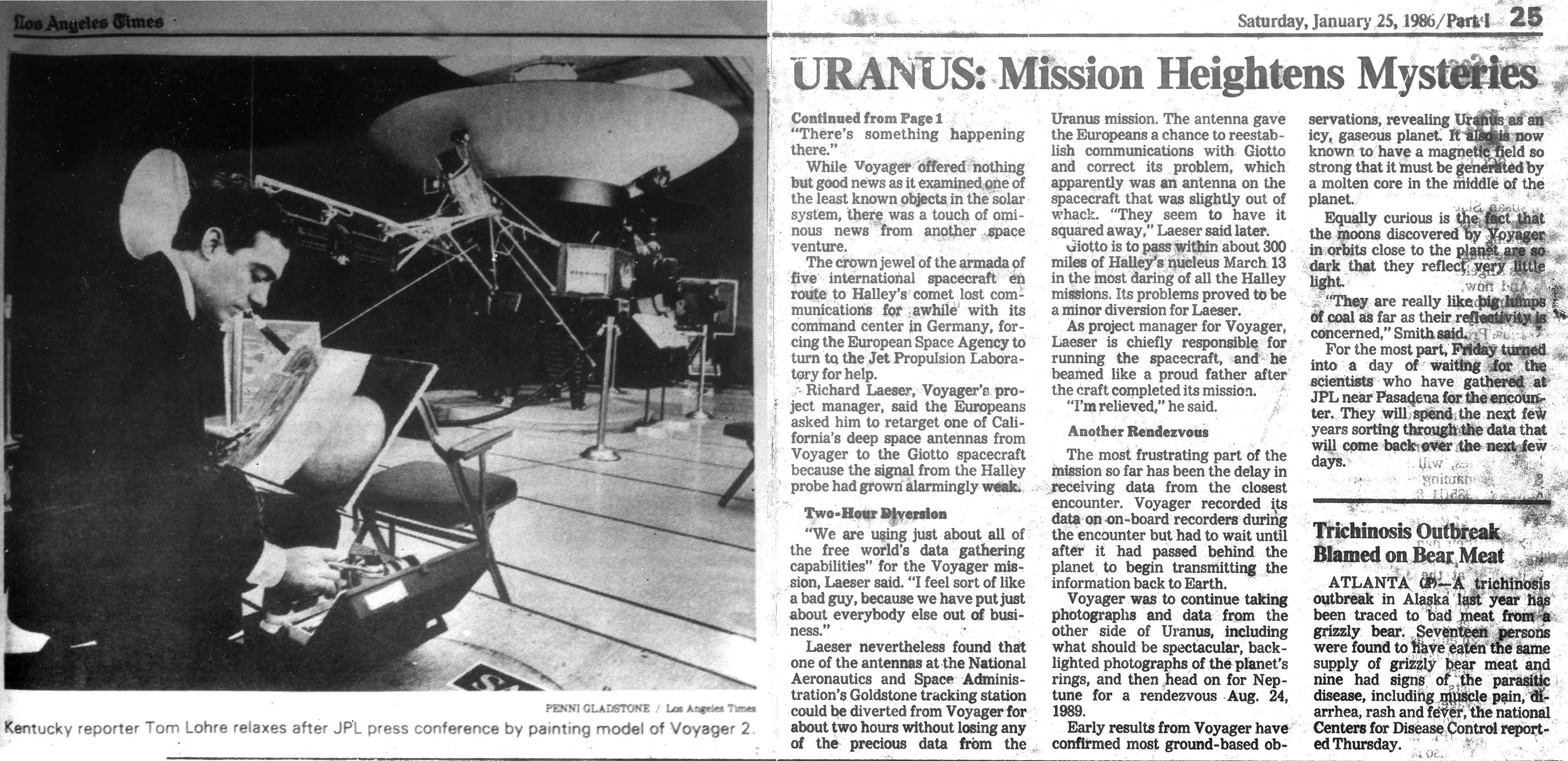
"Tom Lohre Painting Model of Voyager II", 1986, Los Angeles Times, Photographed by Penni Gladstone
Tom started his interest in big planetary events after he went to the eruption of Mt. Saint Helens. He arrived a few days before the explosion and when it happened he spent all day painting several small watercolors. He learned lots of things about that experience. The mountain was a big event and should have had bigger paintings. They should have been colorful but still indicative of the momentous occasion.
After that encounter he had to follow it up with something and decided to go to the first space shuttle launch as a member of the press. He got credentials from Heavy Metal Magazine and showed up with long hair two weeks before the launch. During the encounter he was able to paint the spacecraft two hundred feet from it under armed guard! All in all he could not really translate the occasion on canvas in a manner that was fitting.
After that encounter he latched onto the Voyager missions and went to cover those during the encounter as a member of the press at the Jet Propulsion Laboratory.
These days with the internet, Tom does not need to go to the missions as a member of the press. But that does not solve the problem of space being a very difficult image to address. Tom has furnished many paintings of space for the home. The best ones were used in a male bathroom! Mostly his best images were when he treated the spacecraft, the planet and its moons somewhat like a bowl of fruit! A lot of works were contemporary space scenes from the Voyager missions with the starship enterprise in it! They were very popular!
Today Tom is looking forward to finishing a 5' x 5' painting of Saturn started during the Voyager II encounter and a large 4' x 8' painting of an alien that came to Tom in a dream! He does not see any more space paintings in his future but he has not stopped thinking about how to depict outer space in a real but decorative and meaningful way.
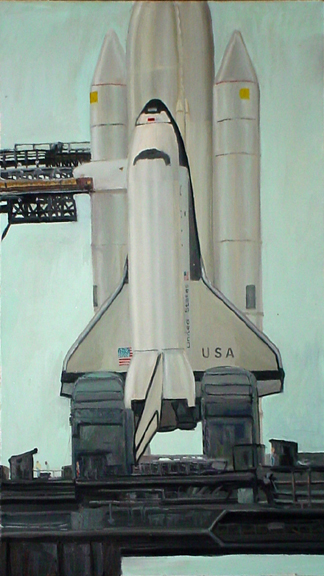
Tom was a member of the press for the first space shuttle launch. He got credentials from Heavy Metal Magazine in New York and flew to Titusville, staying with friends for two weeks while he painted the spacecraft. At the time, Tom had hair down to his shoulders and was 28 years old and rough as far as an artist goes. It was rather overwhelming to get credentials to the Space Center but he did and received a ride from someone that worked at the Center everyday during the mission. He stayed with the granddaughter of a friend of a friend in New York City. They were a fantastic couple with several children in the area. Tom enjoyed their company and got to know the children. Some of them even worked on the shuttle in the tile department. The shuttle had some problems in the tiles that covered the nose and leading edge of the spacecraft's wings to protect it from the 2,700 plus degrees Fahrenheit during the reentry. The temperature drops to 600 degrees Fahrenheit on the upper part of the fuselage. During preparation for the first launch, a lot of speculation went into whether the tiles would stick or not. Tom had learned from the tile team that as many as 10 pieces of documentation went with every tile of which there was thousands. The project had been taken over by women because they were better equipped to deal with the detail of keeping track of all the tiles.
This painting was painted under armed guard, 200' from the shuttle in about twenty minutes. The space center had allowed a group of photographers to travel closer and Tom lifted a ride with them. The first shuttle had a painted liquid fuel tank where the subsequent ones did not. The cool misty day shows no shadows on the spacecraft. Later in the studio, he place workmen around the bottom and finished off some of the details he just roughed in at the pad.
Tom decided to go to the first space shuttle launch because he had just come from the eruption of Mt. Saint Helens. He was there for the explosion and just felt that being somewhere where something big was going to happen might make for a good painting. Later Tom found out that it is not necessarily true. Beauty in the painting, he discovered, came more from the soul than from anywhere else and you could just as easily do a great painting of the spacecraft from your imagination as from anywhere else.
Download "Orbiter" and launch, dock and land the Space Shuttle
http://www.medphys.ucl.ac.uk/~martins/orbit/orbit.html
Saturn and Enceladus, Oil on canvas. 10" x 8", January 1986
Saturn and Voyager II, Oil on canvas. 16" x 12", 1986
Saturn and Voyager II, Oil on canvas. 16" x 12", 1986

Neptune, Oil on canvas. 10" x 8", August 1989
Painted at the Jet Propulsion Laboratory as a member of the press, Tom discovered space paintings were a tough sell as a new form of landscape. Placing the starship Enterprise in such paintings enhanced the value. The most successful of this series are the ones with a reclining lady in her room with a huge space window behind her showing the planets and there moons. These days with the Internet, Tom does not need to go to the missions as a member of the press. But that does not solve the problem of space being a very difficult image to address. Tom has furnished many paintings of space for the home. The best ones were used in a male bathroom! His best images were when he treated the spacecraft, the planet and its moons somewhat like a bowl of fruit!
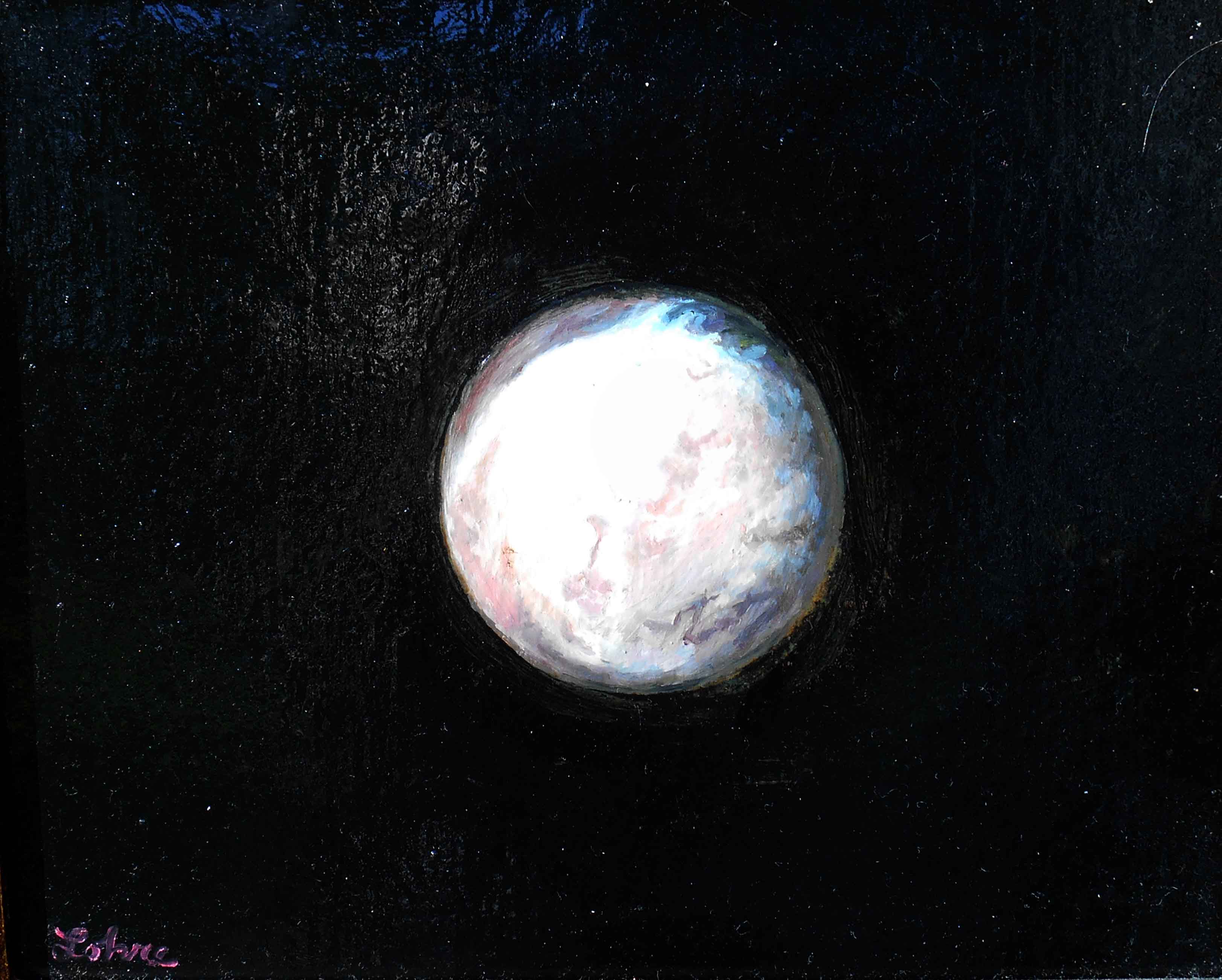
Triton, Oil on canvas. 10" x 8", Auust 1989
Neptune and Triton, Oil on canvas. 10" x 8", 1989, painted at JPL during the encounter.

Uranus and Moons, Oil on canvas. 20" x 16", 1986
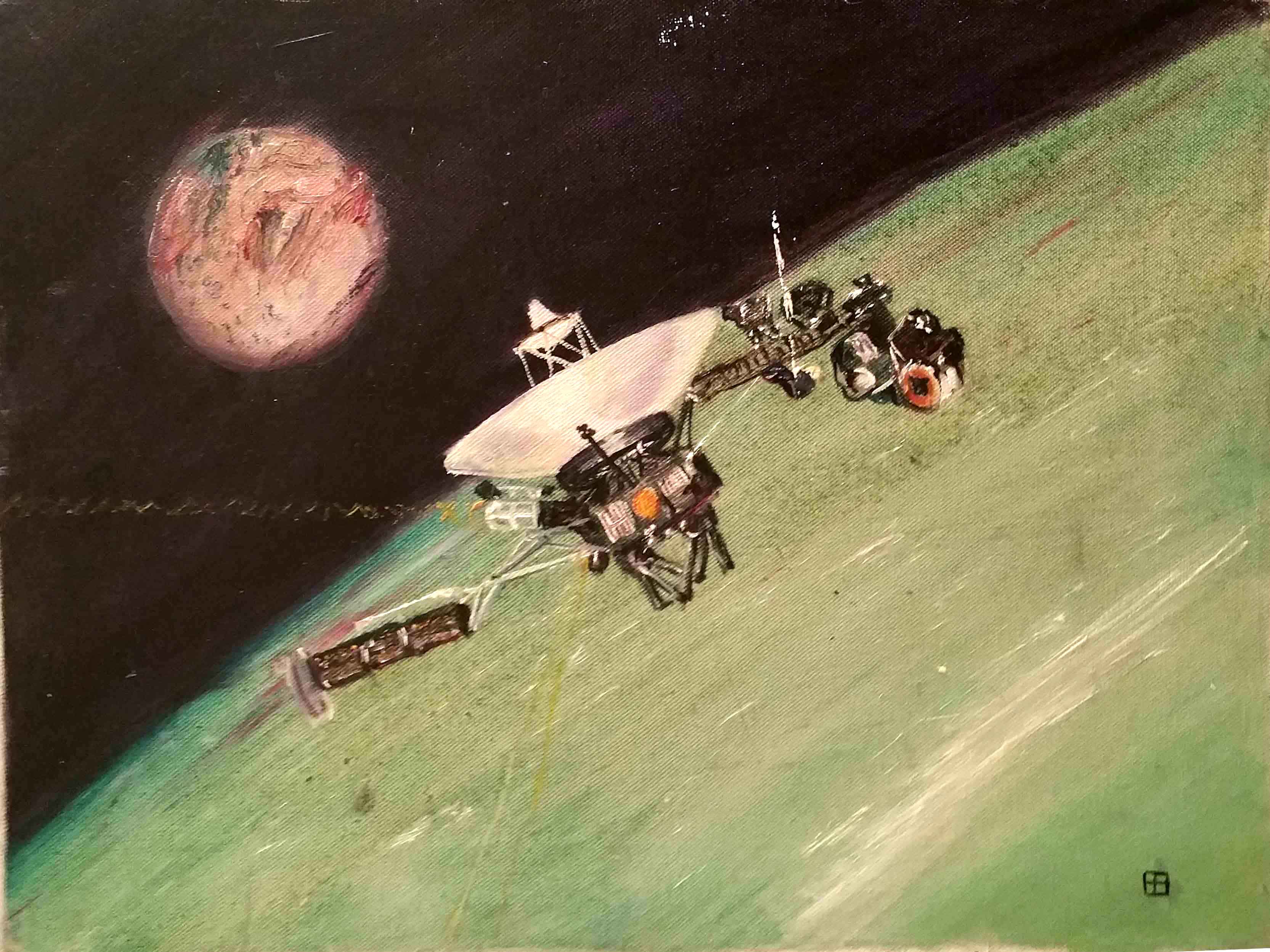
Uranus and Voyager II, Oil on canvas. 16" x 12, 1986
Uranus and Three Moons, Oil on canvas. 10" x 8"

Uranus and
Voyager II with Moons, Oil on canvas. 20" x 16", 1986
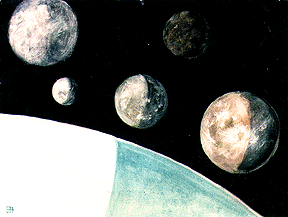
Each moon of Uranus has it's own personality and placed altogether really made of a family affair of moons for a very large and mostly homogeneous planet except for the one large storm circling around but always ending up in the painting. The moons are from left to right: Titania, Miranda, Ariel, Umbriel and Oberon.
Miranda was quite the moon to be discovered and placing it with its planet was just the thing. The large cracks and shape on the moons' surface made it the most talked about moon at the laboratory. It was almost like any data that came in changed all beliefs in what processes had occurred. Miranda has two major feature. One is a V shape on its surface and the other is a cliff. The cliff is three miles high and surpasses anything like it here on earth even though the moon is only 300 mile across.
Oberon's major feature is a large crater with a black center and white rays coming from the dark center. The feature takes up a fifth of the planets surface.
Umbriel for the most part is a black as the ace of spades. Composed of dirty ice it reflects so little light that Voyager's cameras had to expose its cameras extra long to achieve a image. It is only 750 miles wide it reflects only 17% of its light.
Titania, 1,000 miles in diameter, typifies the color of most of the moons with is neutral gray color. It's best feature for the painter is its sharp small craters that gives it a personally all its own.
Ariel, 750 mile diameter, has a rosy color as its best feature. Although it has expansive craters they are not large enough to be painted. The feature are restricted to canal like lines caused by huge fissures that opened up with distortions Uranus gravity holding the moon in orbit.

Uranus and Mary Moon, Oil on canvas. 12" x 16", 1986
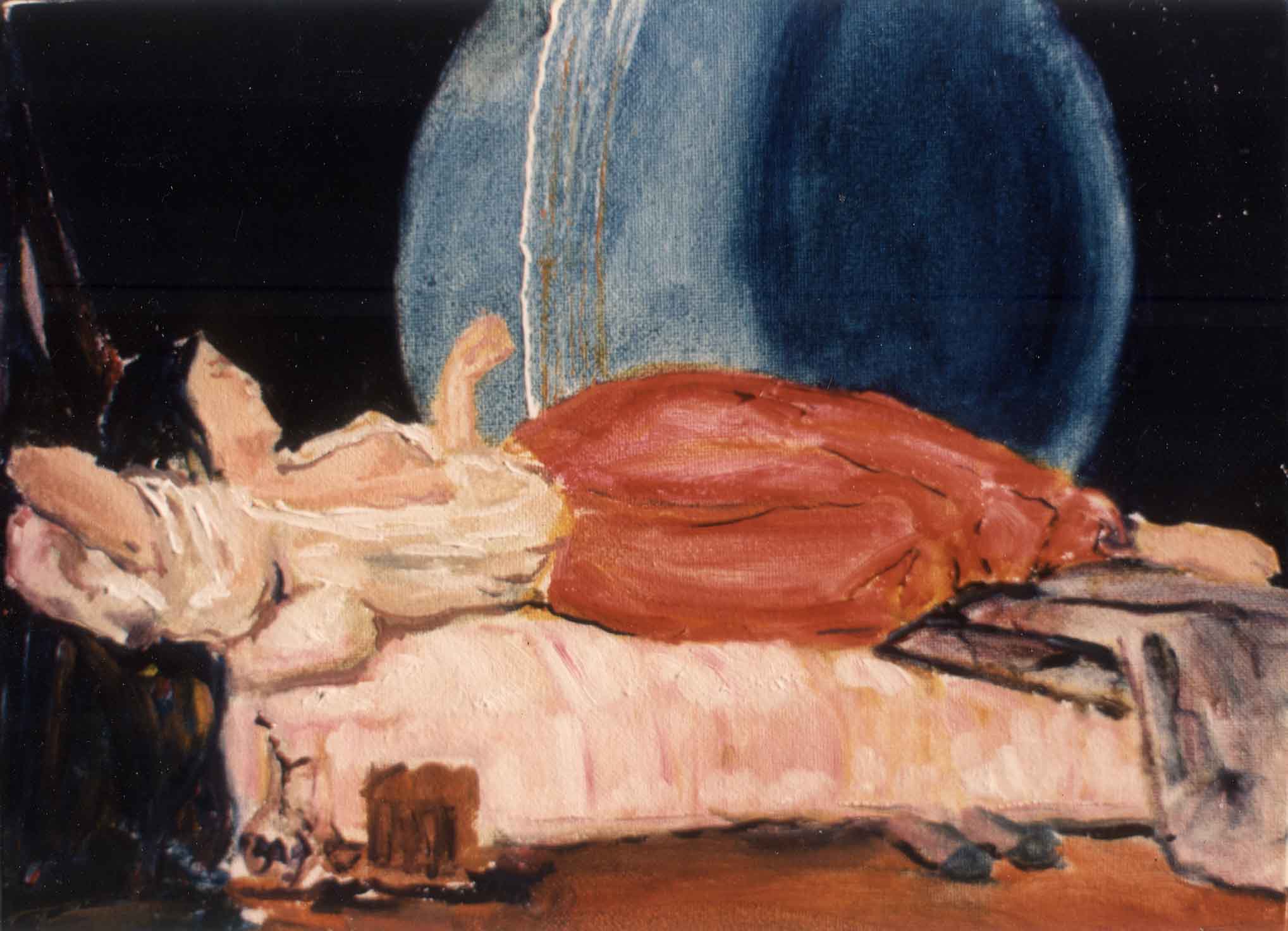
Uranus with Odalis, Oil on canvas. 10" x 8", 1986

Uranus with Nude, Oil on canvas. 10" x 8", 1986
Alien (unfinished), Oil on canvas. 10" x 8", Started in 1981, Property of the artist
View Tom
Lohre' locations of paintings painted from life in a larger map. More
additions to come:()
Experience The Warm Feeling of Owning Original Art
Auctions on Everything but the House Current works Archived Items
See on
Special Web Sites, Family Tree, Friend's Links
Complete Works, Portraits, Landscapes, Still Lifes, Sculpture, Lego Robot Artist...
Experience the Warm Feeling of Owning Original Art
Sign up for yearly notices by sending an e-mail to newart-subscribe@tomlohre.com
Post your comments on https://www.facebook.com/LohreFineArt
126A West 14th Street, 2nd Floor Cincinnati, Ohio 45202-7535