|

Available
Artwork in Chronological Order
Abstract Landscape V, 16"
x 12", oil on board, December 2008
Grant Park, Chicago;
4' x 3', latex on canvas, November 4, 2008
Fountain IV, 12"
x 16", oil on board, November 23, 2008
Sitwell Woman IV, 12"
x 16", oil on board, November 19, 2008
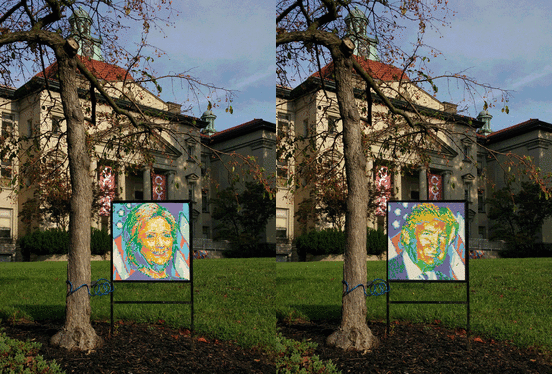
All signs below 28" x 22", waterproof, gloss latex on poster
board, painted on one side, sandwiched with a same size backing board
and place over a wire frame suitable for placing in your yard.

The Bubba Vote refers to the voter
that just cannot vote for a black man.
Barack Rocks

"I'm Mad As Hell And I Want
More" refers to the 1976 made for TV movie "Network." "I'm
mad as hell and I'm not gonna take it anymore!" was said by actor
Howard Beale. Beale is given a two-week notice, and instead of going out
with his quitely he takes over the station.
Hillary Rocks

May Day, May Day, I'm going down
refers to when John McCain was shot down over Hanoi after a bombing mission
in a A4 jet.
"Barrack Obama is a Muslin"
is a gaff on the spelling of the words Barack and Muslin. Muslin is a
cloth. It turns out that most people just assume Muslin is spelled correctly.
The correct word is Muslim.

"Miss Vice President"
refers to Sara Palin's participation in the 1984 Miss Alaska pageant.
"Out of the Haus" refers
to Steve Chabot's run against Steve Driehaus.

"In the Haus" refers
to Steve Chabot's run against Steve Driehaus for the US House of Representatives.
"I love BO"
refers to the popular "I love New York" slogan.

Painted for the summer
of 2008. Tom has always wanted to paint a work for each summer. Finally
he has pulled it off. The 3' x 4' work is effortlessly done using gloss
acrylic paint on sign painters canvas. The two divers are the best of
the season.
Speculative
portraits for sale
Richard T Farmer,
Oil on board, 12" x 16", April 18th, 2008
AG Lafley, Chairman and CEO of
Proctor & Gamble, oil on board, 12" x 16", April 7 2008
Rob Portman, Oil on
board, 12" x 16", April 24, 2008
Lemony Snicket,
12" x 16", oil on board, spring 2008. Painted from a photograph.
David Handler, aka Lemony Snicket, made an appearance at the public library
in Cincinnati and Tom's daughter and he went down to get his signature
and listen to his lecture. He patiently signed and stamped persons book.
David wrote thirteen books in the series of unfortunate events.
The art below was
made with a new process using Lego's MindStorm Invention System.
AG Lafley, Chairman and CEO of
Proctor & Gamble,
oil pastel on aluminum, 16" x 20", April
7 2008
Tom & Irene Kissing
Oil pastel on aluminum, 16" x 20", January 18, 2008
The colors were selected for full color effect. The artist worked alongside
the robot while it places the initial color. Then Tom goes over the work
carefully adjusting the dots. The painting takes place in a novel way,
the painting lays flat and Tom steps back about five feet comparing the
work with his reference.

Lady of Cincinnati's
Fountain Square
Oil pastel on aluminum, 16" x 20", January 15, 2008
Painted with concern over the transition of light to dark colors. The
purple or second darkest color should be lighter. Next painting will be
with real life colors. The
Art Machine used to make these paintings is shown. The eight colors on
the wheel are rotated to the right color and then applied 5000 times.
Baby Bear, Wax on
aluminum sheet, 16" x 20", January 2, 2008
This work continues to improve the resolution and color of the Lego robot,
Artisto assisted work. Tom kept the color lighter than black making the
black a strong form color. He needs to continue to refine the gray scale
steps for the other colors to make the eight colors work as best as they
can.
The Artist as Santa, 16"
x 20", December 19, 2007, Wax
aluminum sheet
This Lego robot assisted
painting has several new inventions. Tom started painting while the robot
laid down the color. He made an outline on the metal of the final painting
and used it to guide his stroke. Tom reduced the size of the wax stick
to 1/4" and kept the number of stroke to 4163. The Santa is the artist.
Tom always wanted to paint a Santa in the manner of the Coke Santa, Haddon
H. Sundblom.
Helen XV, 16" x 20",
October 2007, Wax aluminum sheet
Tom was still working
on the right combination of eight colors for this face of his daughter.
The wax did not have much difference in the dark shades. He still was
working with basic colors, black, dark brown, dark green, dark red, medium
brown, blue, light brown and white. He still would not alter the application
of the color spots, letting the robot make homogeneous patterns of its
own.
Helen XIV, 16"
x 20", October 2007
The light violet takes
the place of yellow in the face palette. If you close your eyes the violet
becomes yellow. The face looks fascinating because of this juxtaposition.
Helen XIII, 16"
x 20", October 2007
Facial coloring combination
from light to dark: black, dark red brown, dark blue, green, red, light
pink, light violet and white with the violet substituting for light yellow
for excitement.
Peter Rabbit,
16" x 20", September 2007
The second painting
where Tom used a 8 color four color process, black, blue, violet, red,
orange, green, yellow, white in that order of gray scale.
Chad Johnson, 16" x 20",
September 2007, Wax on aluminum sheet
This is the second painting done with the Lego robot assistant, "Artisto."
The face is a Bengal receiver. The face is set in the mask of a tiger.
Tom used strong colors to accent the eight colors available in the robot
assisted process.

Helen XII, 16"
x 20", September 2007, Wax on textured aluminum extra heavy foil
Tom worked on mixing
the right colors for this work using 4 light colors for the face and 4
dark colors for the hair. He found out that the darks were too much alike
as well as the face colors.
Helen XI, 16"
x 20", September 2007, Wax on textured aluminum extra heavy foil
One of the earliest works where after the robot had laid down the color
Tom reheated the surface and painted strokes into the hot wax. The ears
at the bottom left are rabbit ears.
Irene, 16" x
20", August 2007
Irene A
The first painting done by "Artisto" using glow in the dark
colors makes use of a strong combination of colors for a powerful graphic
effect.
Irene B
The sky comes to life in the dark. Two different glow in the dark colors,
blue and orange, where used for the background.

Nuclear War, 20"
x 16", oil on canvas, 2006
Paintings
done on location
Waverly Restaurant,
12" x 16", October 27, 2006
Stoney Brook, Long Island, New
York, 16" x 12", oil on board, September 3, 2007
Three Mile Harbor, 16" x
12", oil on board, September 4, 2007
Devou Park Clubhouse, 16"
x 12", oil on board, September 21, 2008
Devou Park Clubhouse, 16"
x 12", oil on board, September 19, 2007

Devou Park Clubhouse, 16"
x 12", oil on board, September 9th, 2006
Both painted during Behringer-Crawford's
FreshArt Event, held every year at this time. Tom participated for the
first seven years and then laid off for seven until now. He just had to
come back because it is so much fun. He knows over half of the artists
and the quests at the auction in the evening. He grew up on the edge of
Devou Park at Breckinridge and Montague Rd. He used to hang out at the
museum when he was ten spending everyday up there with Mr. Crawford.
Entrance to 3-Mile Harbor,
16" x 12, Oil on board, August 2007
The latest in a long line of
paintings done while traveling. Tom's paint box has space for four wet
16" x 12" gessoed boards. Some are panted in one day others
with figures take a week with Tom working on the figure during the evening
and going on location to paint the landscape.
The Balcony, Ludlow Ave, Cincinnati,
Ohio, 8" x 10", Oil on board, April 2006
“The Balcony”
shows the second floor apartment above the shop “Spiral Light.” Tom was
working on another painting when he notices this woman planting flowers.
The ornate railing was always a favorite view and the greening of the
balcony gives direction to the painting. This painting was done just inches
from speeding cars.
Ludlow Avenue Bulletin Board,
12" x 16", oil on board, April, 2006
Tom considers
this a pivotal painting in his “Urban Landscape Series.” By chance he
saw the two women just as they are clothed and depicted. The scene is
simplified of additional objects like bikes, more planters, signs, etc.
but the color and overall effect gave Tom a euphoric feeling he had never
experienced. It was as if the feeling a great painting give the viewer
was continually experienced by Tom as he worked on the painting. He worked
on this painting from Bender Optical. The quite warm office was an excellent
place to work.
Ludlow
Garage in Snow, 12" x 16", oil on board, March, 2006
Tom worked from
inside the barber shop to paint this work. The woman was seen walking
by. You can imagine the spring snow being here on day and gone the next.
You can still see the empty parking spaces from the morning rush hour.
Telford
Avenue with Snow, 16" x 12", oil on board, March, 2006
Sitwell's
Coffee House Interior, 20" x 16", oil on board, March, 2006
Rural Connection, Perry Street,
NYC, 8" x 10", oil on canvas, October 1st, 2005
Fountain Square with Woman, 8"
x 10", Oil on canvas, September 2005
This work was composed in the
studio. The idea for the girl in the foreground was adapted from a photo
Tom took the day before while working on Fountain Square.
Katrina
Relief Fund, 8" x 10", oil on canvas, October 2005
This work painted in Hyde Park,
one of Cincinnati’s Villages. The idea for the girl came from a street
fund raising effort on Ludlow Avenue. Cincinnati’s Conservatory of Music
organized a New Orleans Style Band to set up on the street while other
students solicited money from the passing cars.
Paul
Brown Stadium, 8" x 10", oil on canvas, November 2005
This work painted
outside of Paul Brown Stadium during the week before the game. During
the game Tom discovered that the whole area if crowded with smokers.
Hyde Park Fountain, Cincinnati,
Ohio, 8" x 10", oil on canvas, October 2005
A detail of
the Kilgore Fountain is shown. The girl in the painting was inspired by
a shop clerk who walked the shop dog frequently during the time Tom was
working on the small painting.
A New York City Clean, 8"
x 10", oil on canvas, October 2005
“New York City
Clean” was also painted from life on the streets of New York City. The
painting has quite a lot of street dirt on it from Tom’s sitting so close
to Sixth Avenue. The funniest thing that happened to Tom was a man across
the street dressed up in his Sunday’s finest light gray suit, pastel blue
shirt and light gray shoes. He stood in front a bus across the square
and yelled at it for a good half hour. He was berating the bus for being
parked there. Did not the bus know that the square was called Father Demos
Square because a church burned down on this spot and the city would not
allow the church to be rebuilt so the spot was made into a square for
the sole purpose of remembering the denial of the city? He constantly
said that the square was only to be used for sitting and no bus parking
was allowed. After the man got tired of talking to the bus he came over
to where Tom was working and laid into him. There was to be no tripods
set up. Tom was flabbergasted by the affront. Never had he experienced such
a tongue lashing. Since Tom had his guitar on his lap he was also told
to take that guitar over to Washington Square, there was to be no guitar
playing on Father Demos Square. Tom finally had to tell the man that he
was sorry but the man would have to get the police to have him removed.
After a good long time the man finally walked off. Later while Tom was
talking to a local bench sitter he learned that the man had been diligently
performing his job for several years. He never returned. Father
Demos’s church was rebuilt across the corner into the magnificent “Our
Lady of Pompeii.”
Old Ludlow
Avenue Bulletin Board,
8" x 10", oil on canvas, September 21, 2005
Helen
II, 12" x 16", oil on masonite, August 20th, 2005
Helen,
8" x 10", oil on canvas, September 1, 2005
Rising Sun,
16" 12", oil on board, August 2005
List Farm, Flemingsburg
Kentucky,
6" 12", oil on board,
July 4th, 2005
Emerald Isle, North
Carolina,
16" 12", oil on board,
June 2005
Sugar Loaf Mountain,
Rio de Janeiro,
16" 12", oil
on board, August 2005

Surfers,
16" x 12", oil on board, June 2005
Helen Feeding the Ducks by the
Mike Fink Resturant, oil on canvas, 3' x 4', October 2004
Irene
& Helen, 60" x 40", oil on canvas, April 2004
Helen, 8” x 10”, Oil on canvas,
May 24th, 2003
Helen the Peasant Girl, 8” x 10”,
Oil on canvas, May 26th, 2003
Landscape, 10" x 8",
January 25, 2004
Landscape, 10" x 8",
January 29, 2004
Landscape, 10" x 8",
February 5, 2004
Landscape, 10" x 8",
February 10, 2004
Landscape, 10" x 8",
February 12, 2004
Landscape, 10" x 8",
February 16, 2004
Landscape, 10" x 8",
February 17, 2004
Landscape, 10" x 8",
February 18, 2004
Landscape, 10" x 8",
February 19, 2004
Landscape, 10" x 8",
February 20, 2004
Landscape, 10" x 8",
February 22, 2004
Helen going to School, 16” x 20”,
Oil on canvas, February 22, 2004
Landscape, 10" x 8",
February 23, 2004
Hatfield Coal, 20" x 16",
oil on canvas, 2004
D
E
F
G 
A
B
Over-the-Rhine Alleyway, 16” x 20”,
Oil on canvas C
Abstract Random,
40"
x 26", pastel on 90lb paper, April 1th, 2003
D Helen,
30"
x 24", pastel on 90lb paper, April 10th, 2003
E Tom,
36"
x 26", pastel on 90lb paper, April 15th, 2003
F Helen,
16"
x 20", pastel on 90lb paper, May 18th, 2003
G Helen,
16"
x 20", Pigmented wax on 90lb paper,
May 18th, 2003
Evanswood Place, 24"
x 30", oil on canvas

Esquire Theatre,
Ludlow Avenue, Cincinnati, Ohio, 20" x 16", oil on board, fall
2003, $800
This work was painted from life on a warm fall day, the last warm day of the
year. Tom used a pallet knife to apply the oil paint on a 1/2" piece
of plywood. Tom was studying compositions with large color areas of similar
color.
Old
Bulletin Board
5
x 7, Watercolor of paper
This
is the first watercolor in this series to be completed. Tom decided to
use the annual Clifton Senior Center Fundraising Progressive Dinner as
a motivational force to complete the illustrations of Ludlow Avenue for
these pages. A progressive dinner is where you all meet at a cocktail
home and then branch out to other homes to have dinner and then meet back
again at the church for the auction of art, antiques, gift certificates
from the shops of the neighborhood and other special packages for the
fund-raiser.
Tom
started the drawing from life on the street during the winter and then
completed it in the studio using a four color wash with pens and brushes.
Tom spent about four years perfecting this manner of watercolor working
mostly from Thomas Rowlandson work. Rowlandson, a Englishman, painted
during the time of Charles Dickens in London. Rowlandson would add various
color washes of cobalt blue and alizarin crimson as accent. The technique
revolves around using three different tints for wash and then three different
weights for line. the lines are made from thin brushes to quills.
Humidifier
Painting
5' 6"
x 4', Waterproof paint on "Wonder Board", copper tubing, K
gutter, water pump, January 15th, 2002
Painted as a response
to loud humidifiers and the lack of colorful paintings in the bedroom.
Concrete "Wonder Board" made for tiling was the perfect
surface to use. The 3' x 5' surface is coated with water on both sides.
The Great Tomaso Show
The Great Tomas Pushcart
Sculptura
Flying Bicycle
Sculptura, 5"
x 7", watercolor on paper, 2000
Paintings done
in England

English Village, 10" x 8",
oil on canvas, 2001
Painted from life in a small village right up on the cliffs above Portsmouth,
England. Toms host and he had a Shepard pie dinner that night down the
street. Across the street is the local store. Around the corner is a phone
booth Tom made a few calls back home. He spent the better part of the
day painting on location. The two girls by the faucet as representative
of two painters getting knowledge.

Portsmouth Harbor, 16" x 12", oil on
canvas, 2001
>Painted from life on the second floor of a large riverfront mall complex.
It was windy that day and Tom had to hold onto his canvas as he worked.
He tucked his easel into a nook to keep the rain off.

HSM Victory, 16" x 12", oil on canvas,
2001
Painted from life at the maritime museum. Tom put the ship at sea using
the coastline he could see from his vantage. This was Nelson's flagship.
He was working for a traditional ship at sea painting. The actual ship
was on blocks in a drained pit part of the massive shipyard. The area
is still a active Navy base. Tom purchased a brochure about the museum
from the shop right behind him and used the waves from some of the images
to put the ship at sea.
Helen, oil on brass
cartouche, 1.5" x 1.5"

Price View
February 7 1999, Oil on canvas 10"
x 8"
Painted from the garage of the Price Home.
Situated off a single lane road, the Price home overlooks a pastoral view
of the Carolina Piedmont. Rolling hay fields are line with pine and scrub
oak. A lone tall old tree rises up from the landscape and dares to keep
alive for a hundred years. In the foreground, Rex the neighborhood dog
who adopted the prices watches over the scene.

Mount Adams, Cincinnati,
Ohio, 18" 36", oil on Canvas, winter 2000
Birdseye View
of Clifton, Cincinnati, Ohio, litho on paper, 16”
x 12”
The above drawing is done with
a litho crayon and is a finished work. This is a Birdseye view, just to
the left is the Firehouse, on the right is Famous Skyline Chili. Across
the intersection is Adrian Durban’s Clifton Florist. Just down the hill
is their main greenhouse. The view is of Ludlow Avenue looking West
from the intersection of Clifton Avenue.
Paintings
done with robots
A
B
A Circles, May 13 1999, Watercolor on
paper 20" x 24"
Toms second robot had to be bigger.
It needed larger pieces and the little windup artist could only paint
for a few inches until it needed to be wound up again. That is when I
adapted a remote controlled car into another type of windup painter. The
new motorized version was quite a bit heavier and used a automatic loading
brush. The process yielded a good operating machine along the lines of
the previous windup artist.
B Flying Pigs
February 3 1999, Watercolor on paper
23" x 16"
My first robot that actually painted did
not come until 1999 when I adapted a windup motor I got in a mechanical
junk store in China Town NYC about 7 years earlier. I always wanted to
do just this with the motor but it was not until I applied for a grant
that I needed a real piece of art. The little machine dragged a brush
across a piece of paper slowly and with visual pain. Occasionally
it would pick the brush up and it made the most amazing abstract works.
The whole aspect of these machines is to give them the power to think
for themselves and do what they feel is best.
Read the whole story and see the video
at:

Helen XI, 16" x 20", oil on canvas, 2001
A
B 
A Ryle High School
April 24 1999, Oil on canvas, 10"
x 8"
This painting was done from life from
the Ameristop across the street. Tom had brought his sister there to participate
in the Special Olympics. He painted a carload of boys taunting a short
fat kid with a gun because of the recent shootings in Columbine High School
in Littleton, Colorado where two boys shot 13 people.
B Slater Road,
Morrisville NC
February 9 1999, Oil on canvas, 16"
x 12"
From the story of the painting:
Jesse Marsh grew up here. He is up in
ages now and still has a very handsome distinguished look about him, blond
hair what is left not turn gray with blue eyes. One of his eyes has a
drip in it like an infection. His size was huge bulk with soft large hands
that turn in many directions. I met him while I was painting a smoke house
that was the only thing left from a farmhouse that set near the road.
"There's a well right there also where the satellite dish is now,
he said. The road used to turn off and snake over to where the Sheraton
is now. You can clearly see where the road turned off. Right there was
a number of barns and out buildings. "All this land is good farm
land. Jesse said.

Henry
Williams, August
19 1998, Watercolor on paper, 5" x 7"
A
sketch that started the oil portrait of Henry Williams that hangs in the
Over-the-Rhine senior center. In 1998 he proposed to the City of Cincinnati
a portrait of Henry Williams to hang in the Over-the- Rhine Senior Center
and the City gave him moneys to pay for materials. Tom gave several informal
talks to the patrons of the Over-the-Rhine senior center as he completed
the portrait. At each talk Tom brought the unfinished painting and painting
materials. He would go from table to table engaging patrons waiting for
lunch and speak of the portraits process.
Alzheimer Series
I
believe that people are made up of simple ideas and systems. When a break
down happens the results just tilt things a little but the life continues
in a somewhat normal appearing way.
Painted over the year of 1998,
these watercolors are a bold attempt to change my art into something more
substantial. I thought long and hard and finally Alzheimers inspired
me. It was my goal to use Alzheimer's, as a base threshold to build great
works of art upon.
Done in conjunction with two grant
proposals, Summerfair and the Ohio State Fellowships. It was my intention
to do some honest study of what art was and how the principals of science
could apply. I chose a older woman so as to eliminate the subject matter
from overtaking the primus of the series.
Illustrations:
A
B
C
A Sitting, Watercolor
on paper, 5" x 7", Completed March 3rd, 1998
In the end, sitting is the only
thing I could do. I like my bunny.
B Hanging
Laundry, Watercolor,
5 x 7, Completed August 16th, 1998
Outside, hanging the clothes,
such a simple idea.
C Refrigerator,
Watercolor,
5 x 7, Completed August 15th, 1998
I am putting it away.
A
B
C 
A Gardening,
Watercolor
on paper, 5 x 7, Completed August 11th,1998
Those plants always need attending.
I will just get out there and get to something.
B Cooking,Watercolor
on paper, 5 x 7, Completed August 11th,1998
I am having a gay old time with
my pots and pans.
C
With the
TV Cat, Watercolor,
5" x 7", Completed August 18th, 1998
Talking with the TV and cat are
fine when no one else is around. I believe that people are made up of
simple ideas and systems. When a break down happens the results just tilt
things a little but the life continues in a somewhat normal appearing
way.
A
B
C
A Telephone
for Kitty, Watercolor,
5" x 7", Completed August 17th, 1998
As Alzheimer's slowly progresses
the victim will be found doing strange and different things. Like driving
around looking for their bedroom. Or look always for the key to a lock.
Here kitty has a phone call, and the Mrs._____ never liked cats!
B
Me and My Cats, Watercolor
on paper, 5" x 7", Completed August 10th, 1998
In painting this series of experiments
I was looking for a venue to attack the science of art. I was trying to
make the manner of the paint application make the subject matter more
than it was or even all that it was. As with any research I may be doing
something that had been done before.
C
Dressed for Carnival,
Watercolor
on paper, 5" x 7", Completed August 11th,1998
Something is not the same. I am
in clothes I do not recognize.
A
B
C 
A Bundled
Up, Watercolor
on paper, 5 x 7, Completed August 12th, 1998
One of the 15 small watercolors
was done in conjunction with two grant proposals, Summerfair and the Ohio
State Fellowships. It was my intention to do some honest study of what
art was and how the principals of science could apply. I chose a older
woman so as to eliminate the subject matter from overtaking the primus
of the series.
B
Sweeping,
Watercolor
on paper, 5 x 7, Completed August 11th,1998
There is this long stretch of
land along the pond. I need to keep it clean of leaves and what not.
C
Shopping,
Watercolor
on paper, 5 x 7, Completed August 14th, 1998
I should pick up a box of this.
I do not know if I have enough at home.
A
B
A
Mirror
Looking, Watercolor
on paper, 5 x 7, Completed August 13th, 1998
Who is that person in the mirror?
B
Hiding
Tissues, Watercolor
on paper, 5" x 7", Completed August 18th, 1998
I do not want to be without a
tissue, I think I will save it here under my pillow.

Gentry Tobacco Warehouse, Lexington, Kentucky
July 5 1998, Oil on canvas, 10" x
8"
Painted over four years. Tom's wife spends
a day every summer in Lexington, Kentucky at a professional meeting and
during that time, Tom spent his time researching the tobacco auction business
for a possible painting. His patron had had in their family a large tobacco
warehouse, which they had sold. He wanted to at least have a painting
of it.
Drum Point Light,
Chesapeake Bay
June 24 1997, Oil on canvas, 16"
x 12"
The painting had a lot of sky and water
with just a little more detail than the previous painting. The lighthouse
named Drum Pt. was one of 49 in the Bay by 1900. Of the two thousand or
so manned lighthouses in the US at the turn of the century. Drum point
was rated 248th because of its elaborate Fresnel lens.
Viewers of the painting called it the Thomas Pt. lighthouse because that
lighthouse is still out in the Bay.
Tangier Island,
Chesapeake Bay
June 23 1997, Oil on canvas, 16"
x 12"
Back on Tangier, I finished painting by
1 PM and we enjoyed a crab lunch in the cooler part of one of the many
restaurants that vie for your attention lining the waterfront. Crab is
served in three basic ways. As a round 3 inch by 1 inch fried cake, a
soft-shelled crab fried and boiled hard shell. The fried soft shell has
the appearance of eating a large bug whole. Fully satiated we set off
for Solomons and Drum Pt Light Way Point #67.
A
B
C E 
A Evanswood Place
July 1 1998, Oil on canvas, 30" x
24"
On a blazing hot day in July, Tom painted
the paw paw patch that shares the land with a bird sanctuary, the lone
expanse of land on the street Tom lives on. Every year one of the neighbors,
hosts a Fourth of July picnic and a flyer is sent out. This year Tom offered
to make the poster and painted the part of the street he loved the most.
The sloping hill hosts several hundred-paw paw trees. Tom has harvested
them for several years offering them to the neighbors who hereto for did
not think they were eatable. This last year no paw paw tree bore fruit
because of the drought.
B Public
Market Center, Seattle, 16” x 20”, Oil on canvas, May 24, 1998
Tom
met up with an artist relative who had the next several days off. He took
Tom all over Seattle looking for a place to paint. He settled on a spot
four blocks from his hotel. The market is a mix of the wealthy, tourist
& transients. Over 200 fish, fruit, curiosity & touristy shops
are the attraction. Taking place on a hillside to the sea, the corridors
create a labyrinth of walkways and alleys. The performance is the throwing
of the fish to the packer after a purchase has been made.
Painted as
a typical tourist painting. When I travel I like to paint a scene much
like a person would photograph scenes. The first day in Seattle I traveled
all over the area looking for a scene and finally settled on a view that
was only a few blocks from my hotel. This area of Seattle is quite a tourist
attraction. There are about 200 little shops in the public market selling
everything from fish to shrunken heads. It occupies the whole face of
a steep cliff winding its way down to the seaport docks. A trolley carries
people along the waterfront, which is quite developed with tourist attractions.
The market
was originally created to supply the workers in the city, food for their
dinner. They would shop and then go home. Today, it is much the same and
at 6 Oclock the whole place closes down and is locked up tight.
Only the cities poor and homeless occupy the streets till morning. During
my several days painting on the street I met a Navaho and a Tlingit Indian.
The former was a CAD/CAM computer artist and the latter was the head of
a tribe of Indians that performed native dances.
The painting has a great light
flux. The clouds, like they are most times are heavy with a little patch
of blue, are painted with little pure white. The foreground is dark and
thinly painted. The scene looks like it is about 5:30PM just after the
shops close and before the rush hour starts.
The large sign “Public Market”
is really a funny type of sign that gets caught up in being a important
part of the local heritage. If you look very closely to the left of the
“Farmers Market” sign, that area is where the fish throwing starts.
E Piedmont
Park Gazebo II, Atlanta, Georgia
May 9 1997, Oil on canvas, 10" x
8"
Tom spend a lot of time in Atlanta and
got to know the city quite well. He has painted all over the region and
of all the places; he likes this gazebo in Piedmont Park. In the past,
he did a impressionistic canvas of it and always wanted to return. He
did started two paintings each on different days. The traffic through
that area of the park is quite thick and he was never without human subjects.
Most Atlantians have fond memories of the gazebo.
Paintings
done during Asian Tour
China Man, 10"
x 8", oil on canvas, 1996
Colors: bright green,
bright blue, bright violet, blood red accent
This is the fourth
version. The original was painted from life in the Quanzhou Zoo. Tom and
his wife frantically searched for a scene to paint on their only day in
old Canton. The streets around the hotel were all too crowded but nothing
attracted Tom. They decided to go to the local zoo but even there nothing
caught Tom's eye. Finally he was running out of time and started work
looking at a field of red callas being tilled by a caretaker. The area
around the callas contained the bird cages of the zoo. Tom had learned
that many of the early settlers of the area lived in caves and some of
these aviaries looked like caves. While he worked at a fever pitch Tom
would hear all sorts of strange animal sounds along with Chinese Opera
piped over the loud speakers. Tom and his wife stayed too long and were
locked into the bird sanctuary. They had to climb over the fence and rush
to the gates to avoid being locked inside the closing zoo. Link to the
complete Asian Story by going to: http://tomlohre.com/asia.htm. Prints
are also available.
China Man, 10"
x 8", ink jet print on paper
Governor's Home, Hong Kong, 12"
x 16", oil on canvas, Fall 1996
Our three week Asian trip started
with Hong Kong and then Japan. In Hong Kong the mountains are steep and
there is not much flat land before the water. The Hong Kongese live in
the mountains on winding roads with steep cliffs. In China red soil abounds
with farming taking up every inch. China is moved by people and Hong Kong
by machines. The ability of the Hong Kong to finance improvements is basic
to the difference. China does not finance and wants Hong Kong returned
with no debt!

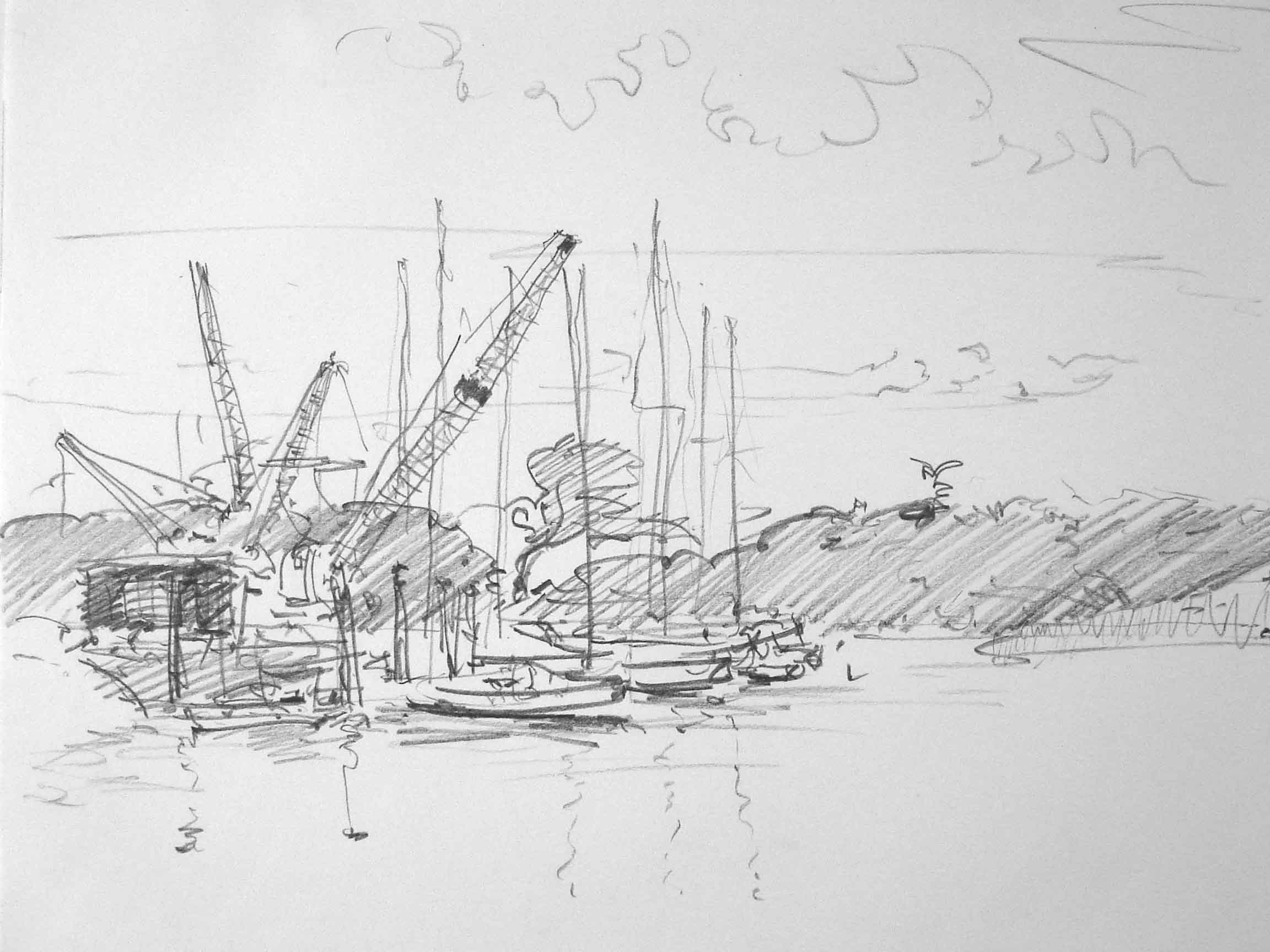
Hong Kong Harbor, 10" x 8",
oil on canvas, Fall 1996
Painted from life during a trip to the
Orient After taking a slow boat to china and the bullet train back. Tom's
wife assisted him in setting up his easel outside the art museum and painting
this view of Hong Kong proper. Normally all the boats in the painting
can be seen traveling to and fro accept the junk. Mostly seen are the
ferryboats and floating cranes that unload all the cargo in the harbor.
Above is a building in the form of a Shinto Shrine at Victoria Peak.
Emiko's
Home, 10" x 8", pencil on paper, Fall
1996

Ancient Japanese Ship, Tokyo Canal Fall 1996,
Oil on canvas, 16" x 12"
Painted
from life and a postcard of an ancient ship. Tom spent several days in the
home of his friend Yuso Hase. Tom had painted his portrait in NYC ten years
prior. Now he was painting the canal outside his hosts bedroom window.
All day long while he painted the weather, seem to want to do everything
in one day. Sun, rain, wind, warmth & cold all followed each other as
the day and the painting progressed.
Paintings done on
location in New York City.
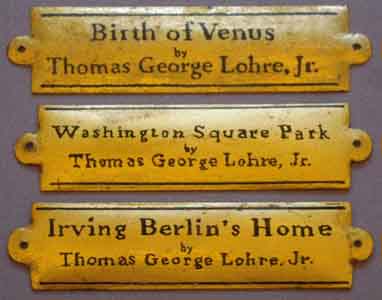
Irving Berlin’s
Home
Oil on canvas,
10” x 8”, October 1996
Painted
from life in the upper east side of New York City. Now the home of the
Ducy of Luxembourg. Tom was staying in a hotel nearby while his wife attended
a professional meeting and made use of the splendid opportunity to work
in the fancy Sutton Place neighborhood. The home was previously owned
by Irving Berlin for many years. Tom knows John Wallowitch, a composer
like Berlin, who lives just down the street. Every Christmas Eve John
and his friends would sing Christmas carols outside his home. Sometimes
Irving would come to the window. While working on the painting for several
days Tom felt quite safe in the ritzy, glitzy neighborhood. A proverbially
who’s who of American and European wealthy would walk by and it was one
of the few places where Tom felt he could leave his paint stand for a
few minutes to go down the street to get a sandwich.
Several
people expressed a lot of interest in the painting while he worked on
it as the leaves fell from the Ginkgo trees that grow plentiful in the
city. It is said that the Ginkgo tree is a prehistoric tree that was capable
of surviving volcanic eruptions and the massive pollutants that come with
such eruptions so is perfectly suited for growing in the polluted city.
Tom had painted many such paintings on the street but worked especially
hard on this one because he was slowly moving out of the apartment he
lived at for twenty years in Greenwich Village and was moving to Cincinnati,
Ohio, where his wife worked and his hometown.
The
composition of the painting is a variation of Tom’s tunnel view down city
streets. In this view the street ends as the cliff begins dropping down
a hundred or so feet to the East River. The color is indicative of Tom’s
strong light and dark manner where the two light fluxes are juxtaposed
against each other. The dark shadow areas are full of variation as well
as the light areas but when a photo is taken of the painting the two areas
cannot be reproduced correctly. Either the light or the dark area has
to be focused on for the light flux difference is so great, very much
like human vision.
Tom
used his yellow light and blue shadow manner. Changing the color of the
light and dark areas to lean towards a stronger color gives piazza to
the paintings.

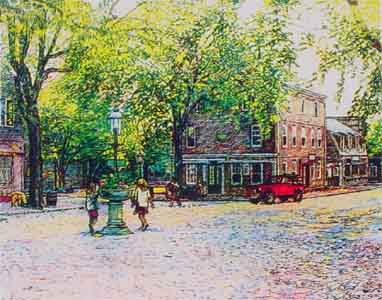
Village Delight, Greenwich Village,
New York City, Oil on canvas, October 1997
This work was painted from life,
one of the last paintings done before giving up his NYC apartment of
twenty years. It was the time where showing in coffee shops was popular
and this place as a shoe in for Tom. He distributed coupons during the
opening for $2 off whatever his guests wanted. For the rest of the week
he painted this view. The players are all characters and much in the
way of a local neighborhood, happenings occurred.

Carolina Piedmont, 16"
x 20", oil on canvas, Spring 1995
Piedmont Park, Atlanta, 10"
x 8", Oil on canvas, September 1995

Li Lac Chocolate, Christopher
Street, New York City, 12" x 16", Oil on canvas, October 1994
This work painted on the street
with the wind and all. The weather was cold those Fall days Tom sat in
the gutter painting what has become a beloved chocolate shop. The owner
liked the painting so much she purchased a duplicate of it. In the painting
delivered to her there was a police officer walking down the street and
two girls admiring the fine chocolates along with their dog.Tom lived
in the West Village for Twenty years. Besides painting many street scenes
he was a social portrait painter traveling the circuit from Nantucket,
New York and Palm Beach. This painting is his best. The view is looking
East on Christopher Street towards where his apartment was. A few blocks
behind is the Hudson River. The time was Fall. The wind was not too bad
as he sat in the gutter for many days painting. The chocolate shop is
still open.
Christopher
St. looking West, New York City
Oil on canvas,
16" x 12", Fall 1995
You can see a tug boat going up river if you look way own the street.
It is only a few blocks to the Hudson River and a easy walk to the cool
breeze. During this painting session the wind was blowing terribly hard.
Tom had to paint while he was holding onto the easel with his other
hand. He later found out that if you ust go around the corner there
will be no wind at all.
Christopher
St. Looking East, New York City , Oil
on canvas, 16" x 12", Fall 1995
This
view shows Tom's old apartment building, the one he lived in for twenty
years from 1978 to 1998. Only the delivery trucks and buses occupy the
street. The local citizens have their automatic wheel chairs along with
the blind girl & seeing eye dog.

Bahamian Home, 20" x 16",
watercolor on paper, 1995
The best example of Tom's large
scale watercolor. He painted it for his wife's birthday. They had just
been there on vacation and this was the view out their front porch. The
town is Hopetown. They were staying next to Toad Hall. All the homes have
names. You can see Irene and Tom on the front pouch. The manner was led
by WInslow Homer. There is a watercolor by him that is quite similar but
more stormy.
Painting done
in North Carolina

Carolina Piedmont
$2,400, fall 1994, Oil on canvas, 16"
x 20"
Tom in the past had painted many landscape
with a power tower in the middle of the composition. Here, on a trip to
the Carolina Piedmont sat in his hotel room working on yet another painting
of the power tower that stood outside his window. Recently married, his
wife asked him not to paint the tower and this is the result, a clear
view of the Carolina Piedmont with its sandy soil, eroding rolling hills
and pine and oak scrub.
Painting done in New
England

Surf Fishing in Nantucket,
20" x 16", oil on canvas, 1995
Painted on location
at the schallop shack in Nantucket Harbor. Tom used the men that gathered
during the day to pose. The boat came from a yard nearby. The idea came
from an image Tom found showing the old tradional fishing method of launching
a surfboat from the beach then paying out net in front of a school of
Sea Bass. Next the boat was rowed ashore and the net gathered and hauled
up on the beach. The shack was a regular meeting ground for the local
men. This painting was done in the fall but in the winter is when it gets
hairy. The warden watches the bay and monitors the men out on the cold
frozen water. If there is any trouble, he can get help out there quickly.

Oak Bluffs, Martha's Vineyard
July 10 1994, Oil on canvas, 20"
x 16"
Painted on location during a sailing vacation.
Oak Bluffs is one of the few places where you can see both black &
white people vacationing together. Tom set up his easel in view of the
congregation tent. In the old days, people would come to worship. Today,
people still come for the religious services. The homes surrounding the
main commons are a combination of tent and home. In the painting, Tom
painted Whoppie Goldberg and Melanie Griffith out of a picture in a magazine.
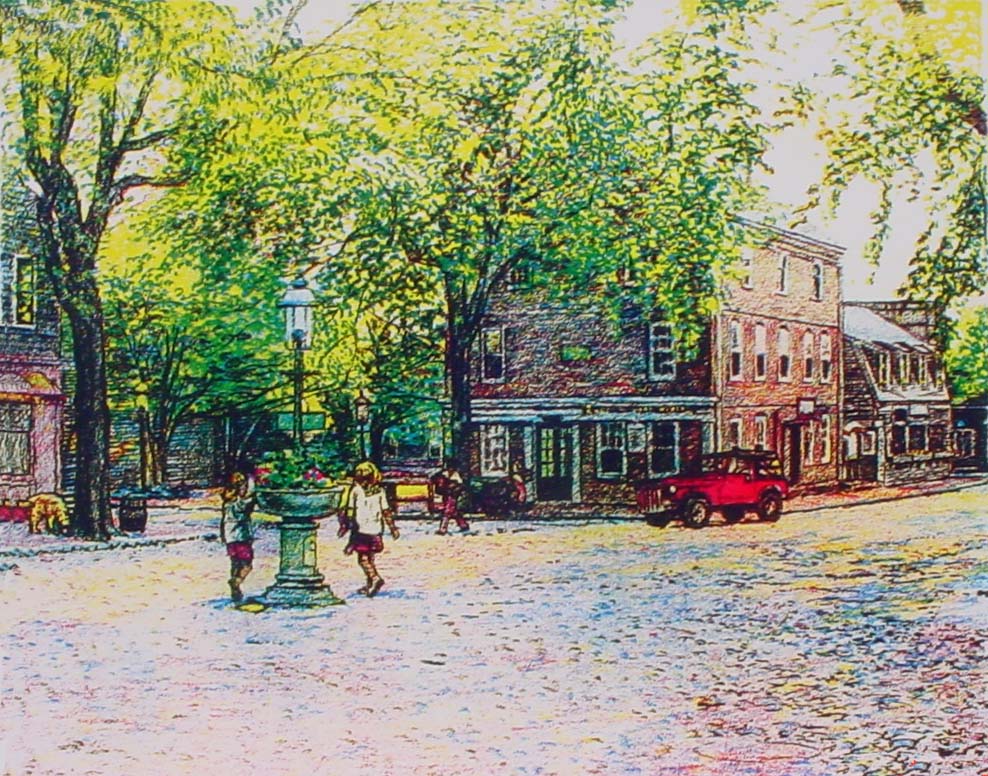
Zero Main Street, Nantucket
July 2 1994, Oil on canvas, 20"
x 16"
One of two paintings Tom did while on
vacation in Nantucket. In the past he had painted this same scene over
and over again but he had sold all of them. This one he did for himself.
It is one of the four different views he painted of the famous fountain.
The view is of a large building that used to be a counting house for the
ships that came into port but today houses shops below and offices above.
During the summer, they hang a large model of a whaling ship above the
door.
Pacific Club, Nantucket
July 1 1994, Oil on canvas, 20" x
16"
Painted during a vacation trip to Nantucket.
In previous years, Tom would paint on the street everyday. Now, while
on a sailing trip he has to return to his learning roots. He would paint
five different scenes of the famous fountain. This view was one of them.
The other five were Zero Main Street, Pacific National Bank & The
Looms. Today there are no large trees for they got too old and died.
Painting
done in Alaska
Tom and Irene were
married on May 26th, 1994. They went to Alaska on their honeymoon. Tom
thought that since it was Alaska he would paint large paintings, so he
finagled a way to transport canvas and stretchers unassembled to Seattle,
their starting point. Once there he assembled 5 30" x 40" canvases
and screwed them together with plates so that their surfaces did not touch.
He could then carry 5 wet paintings in relative protection. That with
his 90lb pack made for easy transport to and from ferries, in and out
of hotels. At the end of their trip the paintings had sufficiently dried
to be able to disassemble them, roll them up and fly back to Cincinnati.
This series of works illustrates the chiaroscuros approach Tom was using
then. His method was to paint a scene with strong lights and darks using
the contrast as a abstract form in the paintings. In "Ketchikan,
Alaska" you can clearly see the strong light cut through the paining.
Mount
Denali, Alaska
June 20 1994, Oil on canvas, 40"
x 30"
Painted in Denali State Park after climbing
up a 2000 foot mountain. You can see the only road that goes into the
park below. Tom hiked up from the parking lot where private cars had to
stop and after stopping every now and then looking for a good view stopped
at the level you can see across the valley. In 45 mile, an hour winds
where the bugs slapped his face and took refuge on the lee side of his
face and as he continually slapped his face with a cloth hat and while
continually holding onto his easel he painted this canvas. His lunch laying
around and the ground squirrels running about discussing his work it was
only after Tom was safe back at the hotel that he realized that a bear
could have followed his scent and showed up to have a bite and a look
see. His wife took the school bus into the park seeing moose, bear
and rams. The bus drivers had signals so they could lewt the incoming
drivers know what they saw. A claw hand for a bear, a fist for a ram,
a spladed hand for a moose.
Mendenhall Glacier, Alaska
June 18 1994, Oil on canvas, 40"
x 30"
Outside of Ketchikan is the edge of the
Saint Alegis Ice Flow. The size of Rhode Island the glacier leads to the
vast ice field in the middle of the mountain range. A tranquil shelter
belonging to the National Park Service offers this view of the glacier.
Tom took the bus from town and hiked a mile up the road to spend the day
painting. Helicopters and tourist passed by taking in the scene on one
of the four rainless days in Juno.
Ketchikan,
Alaska
June 16 1994, Oil on canvas, 40"
x 30"
Painted from life while on his honeymoon.
Tom brought five large canvases with him making his total pack 90 pounds.
Everyday there was a window to paint Tom would set out to spend the day
painting. This view was the finest in Alaska. The day was also special
for it was one of the rare clear rainless days in a town where it rained
360 days a year. In this painting, Tom was experimenting with a novel
compositional method of having a sunlight streak run diagonally through
the canvas.
Inside
Passage II
June 14 1994, Oil on canvas, 40"
x 30"
Painted off the fantail of the ferry.
Tom was using a novel approach to composition. The painting was done as
an experiment in placing various local items on top of a landscape.
Looking closely you can see a sea plane in the water to the right, fins
of the Orcas in the water on the left, salmon jumping on the hill sides
on the right, a mountain man in the clouds on the right and a breaching
hump back whale in the clouds on the left.

Inside
Passage I
June 13 1994, Oil on canvas, 40"
x 30"
After a initial study of the travel
pamphlets on the first ferry out of Bellingham, Tom decided he would paint
the ultimate memory of an Alaskan trip: The breaching of a Humpback Whale
as you kayaked.
Saint Xavier
Three color charcoal
on paper, 8" x 10", 1993
Painting done
in the Bahamas
Boat People IX, 14" x 11",
pencil on paper, 1992
This is the pencil on the final
paper before watercoloring. Most of the pencil is removed with a kneable
eraser after the first inking of the major outlines with a middle tone.
4 hours were needed to work up the drawing. Everything is done in your
head as you try to make the figures come alive without stretching what
is possible.
Boat People VII, 14" x 11",
watercolor on paper, 1992
This is a finished watercolor.
Tom uses three lines weights of line and three shades of each color to
create form. It is a manner he derived from his study of Thomas Rowlandson,
an English watercolorist from the 1800's.
Homer Revisited, 14" x 11",
watercolor on paper, 1992
Here Tom replaced the other black
man in Winslow Homer's work with a woman. He was working in Hopetown,
Bahamas at the time.
Boat People VIII, 14" x 11",
watercolor on paper, 1992
This is a finished watercolor
from his "Boat People" series. Tom considers this work his best
in the series. His wife hangs over the side sick. Tom discovered later
that the boat would normally be packed to the gills with people.
Painted
Bottles & Cans
Black TV star on a wine bottle with the top cut off
Lorena Bobbit on one side and
John on the other on a wine bottle with the top cut off
Watercolors
created for

Greenwich Village A Primo Guide To Shopping
Eating and Making Merry In True Bohemia
$14, Released May 5 1995, by Saint Martins
Press, 27 paintings by the artist adorn the pages. Tom's good friends
and neighbors wrote the book.
Alan Ginsberg
Watercolor on
paper, 8” x 10”, June 1st, 1993
Black Marsha
Watercolor on
paper, 8” x 10”, June 1st, 1993
The
Stonewall Inn, located at 51 Christopher Street, first opened its door
in the Depression year of 1930, having been converted from two hundred-year-old
stables. Utilized for
several decades as a hall for private parties, business banquets,
and weddings celebrations, in the decade of the sixties it became a tawdry
gay bar frequented by preppie types and drag queens like. A callboy service
sometimes operated on the second floor. On the evening of June 28th,
1969, it became the improbable site of the Battle of Stonewall during
a police raid of the place. Robert Bryan, a men’s fashion magazine editor,
was there that night and remembers policemen being driven back by angry
drag queens tired of being intimidated and oppressed by John Law. A prominent
“solider” in the melee was Black Marsha (a.k.a.) Marsha P. Johnson or
Malcolm Michaels), a black drag queen and panhandling Christopher Street
personality for over twenty years. Read the full story in Greenwich Village,
a primo guide by John Gilman and Bob Heide from St. Martins press.
Tom Lohre did the 27 paintings for the guide. Tom lived on Christopher
Street for twenty years.

Bob Dylan
Watercolor
on painted Wild Turkey Whiskey bottle with the top cut off, 3” x
3” x 6”, June 1st, 1993
Crystal Field
Watercolor
on painted wine label with the top cut off, 3” x 3” x 6”, June 1st,
1993
Young
Edward Albee
Watercolor
on paper, 5” x 7”, June 24th, 1992
Tiny Tim
Watercolor
on painted 40oz beer label with the top cut off, 3” x 3” x
6”, June 23rd, 1992
Walt
Whitman
Watercolor
on paper, 5” x 7”, June 23rd, 1992
Sylvia
Miles
Watercolor
on paper, 8” x 10”, June 22nd, 1992
Thomas Paine
Watercolor
on painted 40oz beer label with the top cut off, 3” x 3” x
6”, June 22nd, 1992
Sylvia
Miles
Watercolor
on paper, 8” x 10”, June 21st, 1992
Steve McQueen
Watercolor
on painted 40oz beer label with the top cut off, 3” x 3” x
6”, June 20th, 1992
Sam Shepard
Watercolor
on painted 40oz beer label with the top cut off, 3” x 3” x
6”, June 18th, 1992
Maxwell Bodenheim
Watercolor on
painted 40oz beer label with the top cut off, 3” x 3” x 6”,
June 17th, 1992
Mattheu Bodine
Watercolor
on painted 40oz beer label with the top cut off, 3” x 3” x
6”, June 16th, 1992
John
Wallowitch
Watercolor
on paper, 5” x 7”, June 15th, 1992
Jessica Lange
Watercolor
on painted 40oz beer label with the top cut off, 3” x 3” x
6”, June 14th, 1992

Jimmy Hendrix
Watercolor
on painted 40oz beer label with the top cut off, 3” x 3” x
6”, June 14th, 1992
James Dean
Watercolor
on painted 40oz beer label with the top cut off, 3” x 3” x
6”, June 13th, 1992
Henry
James
Watercolor
on paper, 5” x 7”, June 12th, 1992
George Bartenieff
Watercolor on
painted wine label with the top cut off, 3” x 3” x 6”, June
10th, 1992
Eleanor Roosevelt
Watercolor
on painted 40oz beer label with the top cut off, 3” x 3” x 6”, June 6th,
1992
Edward
Albee III
Watercolor
on paper, 5” x 7”, June 4th, 1992
Edward
Albee II
Watercolor
on paper, 5” x 7”, June 3rd, 1992

Edward
Albee I
Watercolor on
paper, 5” x 7”, June 2nd, 1992
Edna St.Vincent
Millay
Watercolor
on paper, 8” x 10”, June 1st, 1992
Fountain Square III, Cincinnati
May 4 1994, Oil on canvas, 20" x
24"
Painted from life during the Art on the
Square Festival in downtown Cincinnati. Tom imagined this view from the
place he was set up along the skywalk. He was using the patterns in the
square and the glass of the buildings to create a flower arrangement out
of the cityscape.
Fountain Square I
May 2 1994, Oil on canvas, 24" x
20"
The first of three paintings done during
the Art Festival on the Square, a multi leveled event that took place
all over downtown Cincinnati. Tom was painting on the Thursday before
the event from a vantage point where he really could not see the fountain
but having had painted it many times used the opportunity to make a painting
like a bouquet of flowers.

Geek Statue in Drag,
16" x 20", oil on canvas
Seaport Study I, 6"
x 4-1/4", watercolor on paper, 1994
Seaport Study
II, 5-1/2" x 4", ink on velum, 1994
Seaport Study
III, 5-1/2" x 4", watercolor on paper, 1994
Bob Weir, 24"
x 30", watercolor & lytho crayon on paper
John Lennon, 24"
x 30", watercolor & lytho crayon on paper
A
B
C
D
E
A ATT Atrium, New York City, Oil
on canvas, 16" x 20", 1993
B
Zero Main St. Nantucket, 20" x 16", Oil on canvas, August 1993
C Pacific Club. Nantucket, 20"
x 16", Oil on canvas, August 1993
Seaport Impression,
New York City
October 14 1993, Oil on canvas, 40"
x 30"
Painted as a study for a same size finely
detailed work. Done with a palette knife the paint was removed remixed,
reapplied until the color was correct. Some say that this work is even
better than the final version.
Impression of the
Delta Queen, October 10 1993, Oil on canvas, 40" x 30"
Colors: light orange
yellow, violet blue, warm gray, blood red accent. Painted as a study for
a same size oil painting, the final work was extremely detailed and took
a year to complete. This impressionist study was done with a pallet knife.
The color was removed and remixed until the over-all color was correct.
Link to the final painting by going to: http://tomlohre.com/river&.htm.
The painting shows the steamboat Delta Queen just finished docking at
Cincinnati Landing. To the left of the Queen is the permanently moored
showboat Majestic. In the distance, you can see the traditional riverfront
of Covington, Kentucky with its famous suspension bridge built by John
Robeling and finished in 1860. Just behind the bridge is the modern office
tower and contemporary Covington Landing.
Delta
Queen Landing at Cincinnati, Oil
on canvas, 40" x 30", June 11th, 1997
Available in framed photo prints
This painting is the companion of Tom's earlier, same size work of South
Street Seaport. His sister and her husband commissioned the two of them
six years ago. Tom delivered the first painting in the Spring of 1992
and now is glad to deliver the second. It took so long because of the
massive detail in the work and the resolve not to deliver a inferior work.
It was Tom's intention to rival all other work in these two paintings.
The first work was of the restored seaport in New York City near Wall
Street. It had about thirty people on board the schooner "Pioneer"
and about the same number on the wharf. In this "Delta Queen"
painting there were substantially more people.
The paintings shows the steamboat Delta Queen just finished docking at
Cincinnati Landing. To the left of the Queen is the permanently moored
showboat Majestic. In the distance you can see the traditional river front
of Covington, Kentucky with its famous suspension bridge built by John
Robeling and finished in 1860. Just behind the bridge is the modern office
tower and contemporary Covington Landing.
F Winslow Homer Copy
June 1 1992, Watercolor on paper, 22"
x 19"
One of Tom's friends was telling him about
a neat print he had of Winslow Homers. Tom said that it would be much
better to have a real painted copy. Tom painted two of them and the experience
started him on the road to watercolor. After several years, he started
to have a reasonable idea of the necessary talents needed to be an excellent
watercolorist.
Harrisburg, Pennsylvania, 24”
x 20”, Oil on canvas, September 1992
Harrisburg I, 6"
x 4-1/2", watercolor on paper, 1992
Harrisburg II,
6" x 4-1/2", watercolor on paper, 1992

Dick Foster
30" x 40",
oil on canvas, 1991
The painting shows Dick in his
office. Tom changes the regular pink folders for money green. The law
books are South Carolina's. Tom made Dick more athletic than than Dick
was at the time. He used to play tennis every night and golf frequently.
While Tom was living on his estate for a year he painted many works for
Dick. Dick taught Tom how to play golf. Dick had no family when he died
so the painting came back to Tom.
A
B
C
D
E
A Child in Boat, pencil
on paper, 4-1/2" x 5-3/4", 1990
B Reedy Bridge I, Greenville South Carolina
November 26 1991, Oil on canvas 10"
x 8"
Painted after Tom's stay in Greenville,
South Carolina. This is what he considers the most beautiful scene in
Greenville. A small but eloquent steam winds its way through town and
ends up falling over a sizable drop.
C Reedy Bridge II, Greenville South Carolina
November 1 1990, Oil on canvas 10"
x 8"
Tom painted these two works for a show
to be held in Greenville, South Carolina. He had been away for quite awhile
and this was a way for him to recover the fine times experienced there.
D Indian Legend
II, 6" x 4-1/2", watercolor on paper, 1990
E Indian Legend I,
6" x 4-1/2", watercolor on paper, 1990


Washington Square
Arch
Oil on canvas,
10” x 8”, April 23rd, 1989
Inspired
by a ash can school artist, Everett Shinn. His painting was done in charcoal
and had several drunken friends strolling down the center of the street
towards you. Tom painted it from the sidewalk in the Spring.
His
outdoor style of painting evolved in Nantucket. Heretofore he was painting
studio portraits. In 1985 he started taking old master paintings of landscapes,
seascapes and figures in landscapes, mostly of Winslow Homer, and finding
the same type scene in Nantucket and painting that in a smooth surface
traditional manner. That went on for two Summers. He tried all sorts of
scenes, men in boats, harbors scenes and finally settled on five different
views of Main Street. In 1986 he started painting five different views
of Main Street over and over again trying to perfect his landscape painting
manner. He used only fours oil colors to focus on color theory. By the
end on 1986 he was close to perfecting a impressionist manner. Impressionist
meaning painted with a large brush and more paint than needed to cover
the canvas so some of the paint raises up on the canvas. In 1987 he produced
his greatest work in this manner.
His
1987 manner followed him wherever he went and he painted most excellent
works in Key West, Palm Beach, New York City, Cincinnati and Atlanta.
In 1999
the Arch was covered while it is being repaired. Originally erected to
celebrate the Revolutionary War with statues of Washington on the right
and Hamilton on the left. The park was a potter’s field and the last person
hung there was a black woman accused of setting a fire. Inside of the
arch is one large room which could be made into a fantastic coffee shop.
There are two small windows that look out. A very small spiral staircase
goes up to the roof where some avant gart artists celebrated the New Year
by breaking into the arch and spending the night drinking on the roof
declaring the whole Village a bohemian enclave.
A
B
C
D
E
F

A
Bennington College, Vermont
summer 1989, Oil on canvas, 10" x
8"
Painted from life while visiting friends
in the area. This is the college where the black clothes got their start.
The mostly women college would celebrate English by writing poems and
even today it is a hot bed of poetry. This view shows the wide and large
common ground in front of the main hall sitting on top of the hill. On
the left and right are the dorms.
B Triton
January 1989, Oil on canvas, 10"
x 8"
This was Tom's last space painting done
at the Jet Propulsion Laboratory. He had been a member of the press at
several of Voyager II's encounter with the outer planets and Neptune was
its last planet.
C Neptune
January 1989, Oil on canvas, 10"
x 8"
Neptune and its only moon Triton were
painted from photographs sent back from Voyager II. Tom has painted many
space scenes
D Union Street Nantucket
June 1 1988, Oil on canvas, 10" x
8", Painted from life on a V-neck T-shirt when Miami Vice was popular.
Once the gallery owner saw Tom wearing it, it did not matter if it was
gold plated it was not the thing to wear at a Nantucket art opening.
E Mt.
Adams, Cincinnati
January 1 1988, Silk-screen on paper,
36" x 24"
Created using several rubber stamps of
different screen stamped on acetate plates. Regular offset colors were
printed, yellow, magenta and blue. A line drawing was included with each
plate printing black. The overall effect was like the view Tom had come
to know and love. A cold hillside in the dead of winter offered the best
painting conditions for the best view in Cincinnati, Mt. Adams.
F Southern
Most House, Key West
December 20 1988, Silk-screen on paper,
36" 24"
Printed using the colors in a big paint
shed at a screen printing plant that gave Tom carte blanch. The southern
most house is a guesthouse in Key West. It's style and color is unique
to the area. Tom grew with black litho crayons directly onto light sensitized
screens to produce the five colors for the print.

Chemical
Bank, Greenwich Village
May 1 1987, Oil on canvas, 16" x
12"
One of the finest examples of Tom's impressionistic
work. The scene is a normal dirty dusty view from mid Manhattan but the
use of color makes it become more than it is. Tom lived on the street
where the painting was done. He set up his easel in front of the famous
Village Cigars and worked there for several days. As you might imagine,
there were hordes of people moving around him and some felt that they
were put out.
A
B C
D
E
F 
A Sloppy Joe's, Key West
winter 1988, Silk-screen, 36" x 24"
Tom's first silkscreen print after not
having used the technique for twenty years. Tom did many silkscreen posters
for high school and college events. With three, fill colors and a strong
black line drawing. His father thought it was the first work he had seen
of his son's that indicated that he had talent.
B Mead
Paper Plant, Atlanta
January 1 1987, Oil on canvas 16"
x 12"
Painted from the view outside Tom's friend
and fellow painter Rick Houdesheldt. Tom would stop in Atlanta on his
way down to Palm Beach and always painted something. This time it was
a view of a workman getting off work with his son greeting him. You can
see the young boy holding up his dad's lunch box as they walk to the car
where his wife is waiting. This painting ever had much appeal to people.
Tom did it during his great impressionist period where everything seemed
to come up roses.
C 7th Ave South, New York City,
Oil on canvas, 20" x 16", 1987
E Licking
River, 16" x 12", oil on canvas, 1987
Colors: Light violet
blue, light yellow green, deep olive green, purple accent
Painted from life,
this painting represents the best of Tom's impressionist manner which
reached a peak in 1987. In a predictable way Tom’s feverish attack on
learning landscape painting by producing a canvas everyday, working
outdoors on location for two years paid off with 1987 being the peak
of his impressionist manner. Why it peaked and why he could not get
back to this manner has puzzled Tom ever since. His colors were driven
by each other more than attention paid to what the actual color was.
It’s Tom’s belief that nature is a good point to take off from but common
sense is more important in creating meaningful and exciting work. Painted
from life about twenty miles up the Licking River from the Ohio River.
After taking a swim and having some lunch, Tom set up his easel and
went to work on what he considers his finest example of his impressionist
manner.
F Main Street, Nantucket I
, 20” x 16”, Oil on canvas, August 1987
Nantucket, Main Street II, 24"
x 20”, Oil on canvas, August 1987
This larger version of the one
above is the crowning achievement in Tom's Nantucket paintings. He liked
the 20" x 16" enough to make a larger version of it.
Tom painted
on the Island of Nantucket from 1985 to 1989. In the first two years he
worked for James Hunt Barker. In the later years he could be seen painted
five different scenes on Main Street all summer long. He was painting
a canvas a day trying to learn his craft. He has painted more than 800
Nantucket paintings. Heretofore he was classically trained in portraiture
from Ralph Wolfe Cowan, the world's greatest portrait painter who has
painted more royalty than any other living artist.
It took two
seasons for Tom to master a en plein air manner. The greatest canvases
were done in the
Tom married Irene Moore in 1994
and only returned for several years sailing in from East Hampton. When
his daughter was born the sails stopped. He hopes to return.

Tailgate Party, Wellington
Winter 1988, Silk-screen, 36" x 24"
Produced by drawing with an opaque grease
pencil on sensitized silk-screen. He used the quick silkscreen manner
in a painting like way. Image taken from a oil painting that Tom did on
location during the polo races at Wellington, West Palm Beach. After serving
the luncheon to the quests of the James Hunt Barker Gallery, Tom painted
the view.

30" x 40",
oil on canvas, 1985
Painted from life in New York
City. Yvonne is the consummate performer, entertaining with a consistent
stream of cabaret performances accompanied by John Wallowitch. Yvonne
is a long time friend of Tom's having met at an art opening of her son's
work, Rick Prol.

Nantucket Cliff Girl
July 1 1986 Oil on canvas 20" x 16"
Painted in the studio during Tom's second
season on the island. Tom would search through art books looking for a
scene that he could replace the elements with Nantucket scenes. Then after
assembling the drawing in the studio, he would go into the field. This
view is high upon the Northern cliffs of the island. You look down upon
the beach club where you can rent wind surfers and sunfish. The Jetties
extend northward to make a break for the channel to the main harbor.

Greek Statue Dressed In Drag
May 1 1985, Oil on canvas 16" x 20"
Painted in the studio in New York City.
Tom had for the last couple of years, been painting famous statues into
strange and different scenes. His mission was to discover the exchanged
form to see if it held up in a very different surrounding. The dress he
chooses for the statue was not unlike what you might see if you walk out
of his apartment. Living on Christopher Street availed many such signs
because it was the gay street in the City.
5' x 5', oil
on canvas, April 2nd, 1981
Panted from life in Atlanta. Tom
lived with George for several months while he completed the work. The
rugs and painting were dear objects of George. The painting is a Maurice
Clifford's. Out the window you can see the view from Moore's Mill road
looking towards Atlanta. Tom was introduced while George was visiting
New York City and he commissioned his portrait. Just before arriving Tom
had spend several weeks in Titusville, Florida painting the first space
shuttle launch. George died suddenly of a heart attach at the age of 45.
The portrait went to his father who dearly loved the portrait. The portrait
being life size made it seem as though his son had not left him. After
many years his father was checked into a nursing home and Tom worked with
his close friend to have the painting shipped back to him. George was
a art dealer in Atlanta and Tom had a one man show there in his gallery
Nassau Visions in June of 1982.

Space Shuttle Discovery,
18" x 24", oil on canvas, 1980

4' x 5', oil
on canvas, November 1st, 1983
Painted from life in New York
City. Rhett commissioned two such paintings one for each of his boyfriends.
The style of the painting closely emulates Tom's master, Ralph Wolfe Cowan.
Tom had been living and working with him in Palm Beach for a year. The
composition is arranged around the sun signs of Rhett and Todd. Tom spent
a good amount of time studying bulls at the Bronx Zoo but Rhett preferred
a horse. The horse is painted in the manner of the Arabian stallions Ralph
had been painting for the Sheiks of Saudi Arabia.
Alien
(unfinished), Oil on canvas. 10" x 8", Started in 1981

Mt Saint Helens, Eruption I, From Tum
Tum Mountain, Washington
May 18 1980, Noon, Watercolor on paper,
12" x 9",
On Sunday after a night of partying because
Sunday was a free day Tom slowly woke up around eight in the morning.
Looking outside the sky was cloudy. It was not suppose to be cloudy and
after a little thinking, everybody realized that the mountain had exploded.
Everybody piled into the car and made out for Tum Tum Mountain about 27
miles to the South of the exploding Mount Saint Helens. From that point
Tom worked the rest of the day painting four watercolors as fast as he
could.

Hiroshima mon
Amore
Oil on canvas,
1979
The oil painting shows a woman
looking up at a floating earth. A snake encircles the earth and is about
to strike. Below the earth is a tiger who is about to bite the snake.
In the background is a nuclear explosion. Behind the woman is a tall ornate
enclosed chair.
Painted for Birdie Bloch, a great
patron of Tom's. He painted her portrait several times and in this painting
she let Tom do what he wanted. He painted an allegory about the benefits
and dangers of Nuclear energy. Tom spent a lot of time at the circus to
study the tigers. The bench is from the Metropolitan Museum of Art. The
blast in the background was from a famous nuclear cloud photo.
The painting is an allegory of
threat. Painted in 1980 at the end of the Cold War it was meant to show
the nuclear treat of the Cold War. The woman represents humanity and the
tiger in front of her represents the powers available to her. The chair
behind her represents her authority. The Earth represents herself and
the snake represents the treat of a nuclear holocaust. Today the
treat is different but still there.
Flowers a la Tour, 20"
x 16", oil on canvas, 1979
Parrot, 18.5"
x 40", oil on board, 1979
Colors: Emerald blue,
gray blue, red earth, olive greenThis very early work was painted from
life in a pet shop on Bleecker Street in Greenwich Village, New York City.
Tom work for several days in the pet shop in very tight quarters. The
painting is done on an old door made out of 1/4" plywood harkening
back to the days when Tom could not afford canvas and stretchers.
Mike
Fink's Restaurant; Covington, Kentucky
Oil
on canvas, May 15th, 1978, 28" x 18"
Clare
E. Beatty
Oil
on canvas, May 1st, 1976, 36" x 24"

Dad on his Morgan
36'
5-3/4" x
4", watercolor on paper, 1973
Painted from life in Sandusky,
Ohio while Tom was in college.

259 as of 090220
|