
This page had continually been in the top ten of the highest number of hits of all my pages. There must be millions of people looking into slit drums:()
Inspiring Smiles Forever
Inspiring Smiles Forever
Look to these pages for the latest from the studio and the boat yard. This is a simple web site with no cookies or security hosted by Go Daddy. Trust they will let you have fun browsing.
Complete Works, Portraits, Landscapes, Still Lifes, Sculpture, Lego Artist...
Click To Sign up for auction notices or check past auction sales at EBTH
Have any Tom Lohre painting on Prints, Greeting Cards, Throw Pillows, Duvet Covers, Shower Curtains, Tote Bags, iPhone Cases, T-Shirts, Round Beach Towels, Towels (Beach & Bath), Yoga Mats, Spiral Notebooks, Fleece Blankets, Portable Batteries Chargers, Carry-all Pouches, Weekender Tote Bags, Coffee Mugs, Tapestries, Face Masks, Jigsaw Puzzles, Stickers and Oraments via Fine Art America
If you don't see your favorite painting request it to be offered.
Post comments on Facebook https://www.facebook.com/tom.lohre/


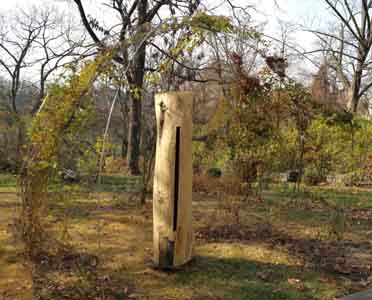
Video of drum played with a stick
https://www.youtube.com/watch?v=8giaACi-dAU
Video of the drum played by the wind.
https://www.youtube.com/watch?v=9Rm2NzZ5uKg
Our Slit Log Drum
A log was in a neighbors backyard about 20" in diameter and six feet long, naturally hollowed out with about 1-1/2" of solid wood around, good for a long distance talking drum. One day in the fall six years ago my neighbor and a friend sawed off the hallowed log and hauled it up to my home. I hung it in a tree using a natural hole till November of 2014. Pounding on it with a cypress hammer, it made a pleasant sound. Taking it down after so many years, the outside was shaved with an electric planner, then filling the top and bottom were capped with can foam used for insulation. Drums like this can be heard seven miles away.
Drums were forbidden on slave plantations. Instead slaves used traditional string instruments. Also american natives tried to pass as slaves for slaves were treated better than american natives. This is where the blues came from. It was a fascinating synergistic phenomenon that changed the world.
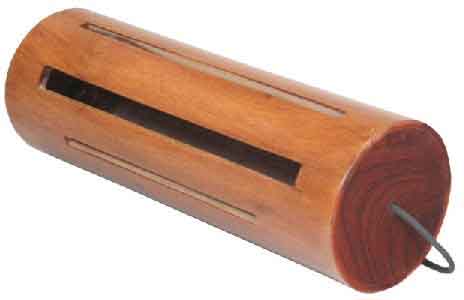
7" x 20", rosewood, 3 slots, different slots create different tones. Includes wooden beaters. Made in Pakistan.
Slit log drums produce various tones from the slits in the log. Slit log drums were developed simultaneously by several cultures as a way to send messages that could be heard over great distances. These cultures lived in places where large trees grew (including parts of Africa, Asia, the Pacific Rim, and the Americas) and they sent messages using drums made out of huge logs. They would take a log from a large tree; the bigger the log, the bigger its sound would be and the farther it could be heard. A long slit would be cut in the side of the log, and the log would be hollowed out through the slit, leaving wooden ledges, or lips, on each side of the slit. If they wanted the drum to be able to make a lower note and a higher note, they would hollow it out more under one lip than under the other. To play messages, they beat on the drum's lips with sticks, beating out rhythms of high and low notes. In modern times, slit log drums are used mostly for music.
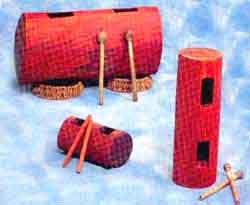
These drums are hand carved from solid logs of paduc wood in Eastern Nigeria. By leaving one wall of the log a little thicker when carving, they create two different tones on either side of the slit. This is traditionally a "talking" instrument, capable of transmitting messages by sound over long distances.
In modern times, these log drums are used mostly for music. Each drum has a few "sweet spots" which produce especially nice tones. It is possible to get more tones by hitting the drums away from the sweet spots, also.
From From Wikipedia, the free encyclopedia
A log drum is a type of unpitched percussion instrument that creates its resonance with two tongues that are carved into a hollow box. This box is usually made out of cherry or maple wood. The two tongues are carved in a manner such that one is higher pitched than the other one. When a tongue is struck, it vibrates, resonating through the box-like chamber and creating a dark mellow tone. The instrument is to be played with soft rubber or yarn mallets.
http://www.philtulga.com/Talking%20with%20Drums.html
Drum Language of the Congo
- using vocabulary in the context of phrases -
Welcome to my page on Drum Language of the Congo. It includes: 1) an explanation on how drum language works; 2) an online virtual log drum you can play right now on your computer; 3) fun facts about drum language, and 4) multimedia activities that integrate drum language with other areas of the curriculum! So, take a couple of minutes to read more about this amazing form of communication, learn how to play a couple of phrases on a virtual log drum, and explore some surprisingly fun connections we can make with drum language.
How Drum Language Works
The Lokele people of the Congo use two-tone log drums to communicate phrases in their language. They can accomplish this because their language is tonal. That is, each syllable in a word has a high or low tone. The tonal patterns that result in their speech are the same tonal patterns that they drum. By communicating in this way, they create drum language in which their vocabulary is always understood in the context of phrases. Listen to Phil explain how this works by pressing the Play button below.
Virtual Log Drum
The Lokele use a two-tone percussion instrument they call a boungu or bongungu. It is made from a solid log of reddish-brown wood with the scientific name Pterocarpus Soyauxii. Given it's design, it is actually a wooden slit-gong rather than a traditional drum.
They begin by chiseling out a long narrow slit along the length of the log. Once the slit is deepened to the halfway point, they hollow the two sides until two lips are formed — the thin side or low lip produces the low tone, and the thick side or high lip produces the high tone. The two tones are typically tuned to either a major or minor 3rd. Our virtual boungu is tuned to a major 3rd.
Let's listen to it. Start by clicking your mouse on each side of the slit. Notice how one side produces a lower tone, while the other side produces a higher tone. The sounds you hear were recorded from an actual Lokele boungu, located in the forest on the edge of the great Congo River.
Now let's learn two Lokele words, and the phrases they drum for context. Notice
that their word for "bananas" has the same tonal pattern (three low
tones) as their word for "up" or "above." However, when
you drum these words in the context of a phrase, the difference between them
is quite clear. In this drum language, vocabulary is always understood and defined
in the context of well known phrases.
Lokele English
word: likolo (L L L) up or above
phrase: likolo ko nda use
(L L L L H H H) up above there in the sky
Lokele English
word: lik?nd? (L L L) bananas
phrase: lik?nd? libotumbela
(L L L H L H L L) bananas which must be propped up when ripe*
* because ripe bunches of bananas tend to fall over on their own weight
Fun Facts
1) Question: What is the best time to send a drum language message? Answer: The Lokele prefer to send messages in the early morning or late evening, when the air is cool. As air cools, it becomes more dense and carries the sound waves a greater distance.
2) Question: How far can one drum be heard? Answer: The sound of a single log drum usually travels the distance of 4-5 miles during the heat of the day, and 6-7 miles during the cool mornings or late evenings.
3) Question: How do the Lokele communicate with distant tribes that speak different languages? Answer: Drummers in boundary villages are often bilingual — they can communicate in Lokele drum language, and the drum language of neighboring tribes. These bilingual drummers are usually children of parents from two different villages. They learn both languages and become proficient in drumming.
Extensions
Learn how to make a homemade drum and sing Lokele phrases.
View Tom
Lohre' locations of paintings painted from life in a larger map. More
additions to come:()
Experience The Warm Feeling of Owning Original Art
Auctions on Everything but the House Current works Archived Items
See on
Special Web Sites, Family Tree, Friend's Links
Complete Works, Portraits, Landscapes, Still Lifes, Sculpture, Lego Robot Artist...
Experience the Warm Feeling of Owning Original Art
Sign up for yearly notices by sending an e-mail to newart-subscribe@tomlohre.com
Post your comments on https://www.facebook.com/LohreFineArt
126A West 14th Street, 2nd Floor Cincinnati, Ohio 45202-7535